
A VPN's logging claims, encryption protocols, leak protection, jurisdiction and handling of security incidents can all be verified item by item. The article takes these five dimensions apart and explains what encrypted egress and browser environment isolation each solve.
Judging whether a VPN's privacy promises are worth trusting by reading its marketing page does not work. The things that can actually be verified are just a few: whether the logs have been examined by an independent body, how encryption and keys are managed, whether leak protection is complete, which jurisdiction the company falls under, and how an incident is handled after it happens. Taking NordVPN as a reference object to break these dimensions apart, the method can be applied to any provider.
No-logs claims: look at who signed off
Almost every VPN says it keeps no logs, and that sentence on its own carries no binding force. The meaningful version is: an independent third party performs the audit, it states explicitly which servers and which data types are covered, and the report is made public.
NordVPN has published no-logs audit reports issued by outside organizations, covering its server infrastructure and the enforcement of its privacy policy. There are two easily overlooked points when reading such reports. First, the timing of the audit: passing once only reflects the practice during that period, and any later change of architecture or data center requires a new audit. Second, the scope of the audit: checking only whether connection logs are recorded is a different matter from checking that together with session duration and traffic metadata.
If a provider has nothing but a slogan and cannot produce any downloadable report, this item can basically be crossed off.
Encryption protocols and key management
NordVPN uses NordLynx by default, an implementation built on WireGuard, and also keeps OpenVPN and IKEv2 available as options. The WireGuard family of protocols has a small codebase and high throughput, at the cost of not including dynamic IP assignment, so every vendor adds a layer of its own handling on top. It also offers multi-hop links, letting traffic pass through two servers before it exits, which gives better anonymity at higher latency, suited to specific scenarios rather than being left on all the time.
On the server side, what deserves attention is the degree of persistence. Building servers so they run only in memory and are wiped on restart means far less historical data can be obtained after physical access, and NordVPN's servers have this property. Parameters such as forward secrecy and tunnel renegotiation frequency can be found in the official documentation and are worth reading through once.
DNS, IPv6 and disconnect protection
Once the tunnel is up, leaks can still occur elsewhere. If DNS queries do not go through the tunnel, or IPv6 traffic is not taken over, the domains actually visited are exposed to the local network. WebRTC is another common leak point, with the browser opening a separate channel to report local and public addresses.
The verification method is not complicated: after connecting, run a DNS leak test and a WebRTC test and see whether the resolver and addresses returned belong to the VPN network. Whether a network lock catches the fall when the connection drops is equally critical, since many incidents happen in the few seconds when the tunnel briefly fails and traffic falls back to the local egress. NordVPN's kill switch and threat protection are mechanisms of this kind, and the latter blocks known malicious and advertising domains at the network layer.
Registration and corporate ownership
NordVPN is registered in Panama, with its operating entity in Europe. Jurisdiction determines what a provider is legally required to hand over, and whether it can refuse, when a data request arrives. Panama is not part of the common intelligence-sharing alliances, which is a frequently cited point, but that does not mean there are no compliance obligations; the European operating entity is still bound by local regulations. Reading transparency reports is more useful than reading the place of registration, because the report sets out how many requests were received in total and how many were complied with.
How an incident was handled
In 2018 one of NordVPN's servers in Finland was compromised, and the entry point was a remote management account provided by the data center, not a break of the encryption itself. The company subsequently made a public statement, rotated keys, and pushed forward with converting servers to memory-only operation and with stricter third-party audits.
The standard for judging is not whether an incident ever happened, but whether disclosure was timely, whether the explanation was specific, and whether remediation can be verified externally. Providers that stay quiet carry higher risk.
The half that a VPN cannot solve
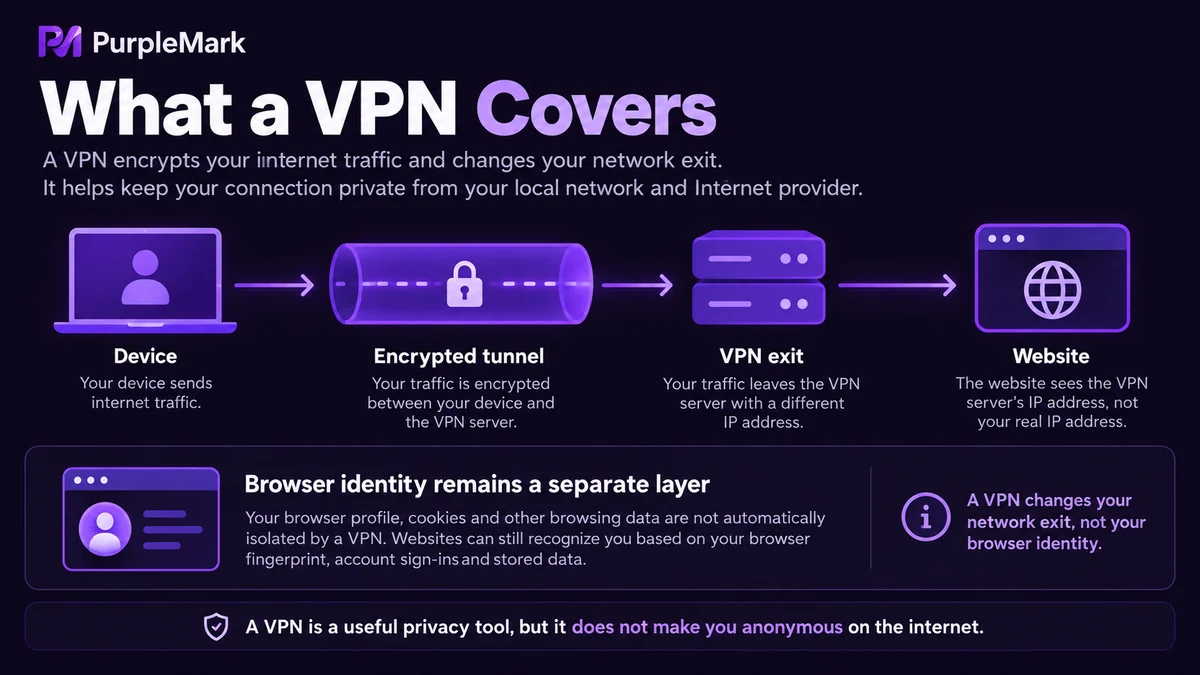
Passing all of the items above only shows that the network egress segment is encrypted and disguised. Nothing inside the browser has changed: Cookie, local storage, Canvas and font fingerprints, time zone and language, device characteristics, all still exactly as they are on the local machine.
When the same person accesses two accounts through the same egress, or accesses two accounts opened on the same computer through two egresses, what the platform side sees is still a highly overlapping environment. People doing cross-border e-commerce, ad placement or social media operations often treat this as simply changing the IP, but in fact the basis for judging account association goes far beyond IP.
Multiple accounts, multiple environments and team collaboration are a different class of problem, and what they need is account-level browser environment isolation: a separate profile, Cookie and local storage, egress IP and device characteristics for each account, mutually invisible. PurpleMark provides exactly this kind of environment isolation, managing profiles, network egress and device characteristics separately by account, so that credentials do not have to be carried back and forth between machines.
Teams operating in several markets can assign accounts to different environments by market, so that troubleshooting does not tangle several business lines together, and one person's mistake does not drag in other accounts. When multiple people need to collaborate, use PurpleMark sub-accounts to allocate environments by project; members do not share the same login environment, and operation records are retained.
Handling egress encryption and environment isolation separately lets each solve its own problem; mixing the two in one discussion tends to make both go badly.


