
Overseas business operations come with many IP terms: residential, native, broadcast, datacenter, static, dynamic, dedicated, and shared. This guide organizes them by “source” and “allocation method,” then explains which business scenarios each type suits so you can choose proxies without getting lost in terminology.
When doing business overseas, proxy IPs are used almost every day—whether you run TikTok, Facebook, or Amazon accounts, place ads, or collect data, you will encounter terms such as residential, native, broadcast, datacenter, static, and dynamic. Proxy providers also like to promote labels such as “US native residential IP” and “dedicated static IP,” which can easily confuse newcomers. This guide sorts these concepts by “source” and “allocation method.”
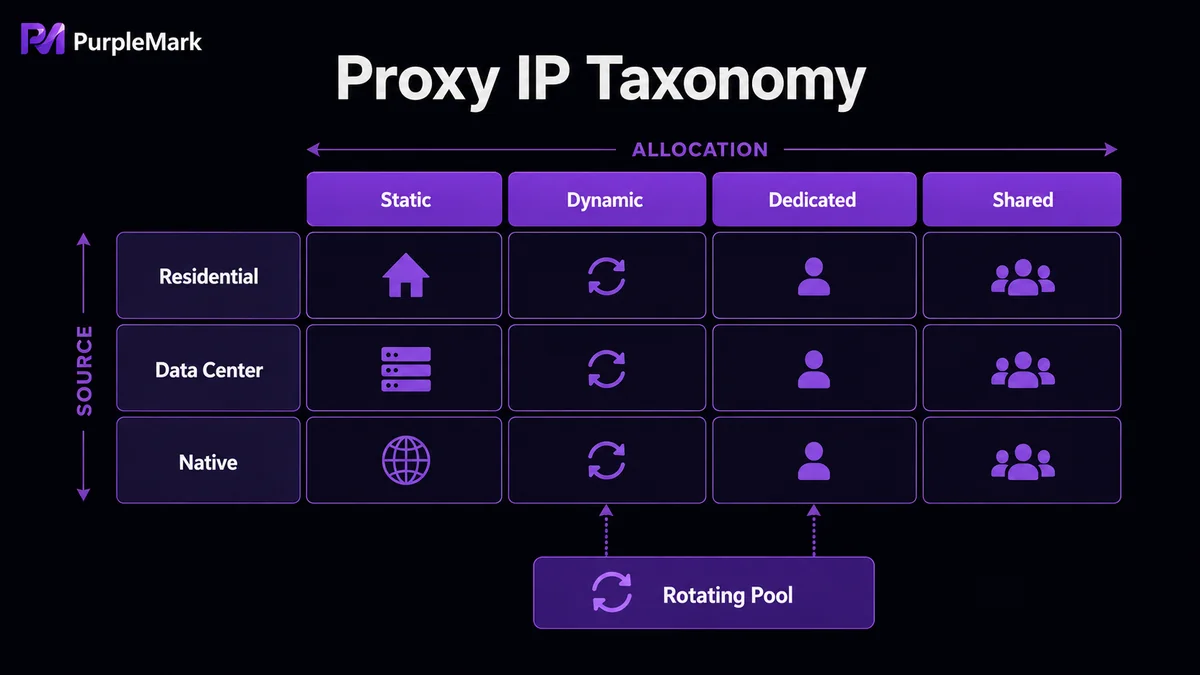
First, separate the two dimensions used to classify IPs
Many people mix residential/datacenter with static/dynamic, but they are actually two different dimensions:
- By source: residential IP, datacenter IP, native IP, broadcast IP, and so on.
- By allocation method: static IP, dynamic IP, dedicated IP, shared IP.
We will explain them separately below.
Residential IP: closest to a real user
Residential IPs come from home broadband providers (such as Comcast/AT&T in the US and SoftBank in Japan) and are genuine residential network addresses. To a website, they look much like the IPs ordinary users browse from every day, so they generally have a high level of trust.
- Suitable for: registration, long-term login, advertising, and cross-border operations on platforms such as Facebook, TikTok, Instagram, and Amazon.
- Note: they are usually more expensive. If you only need website testing, API debugging, or routine data collection, residential IPs may be overkill and datacenter IPs are often more cost-effective.
In short: if your goal is to operate accounts stably over the long term and reduce risk-control triggers, prioritize residential IPs. If you only need a proxy that can access a website, residential is not always necessary.
Native IP: more of a “description” than a fixed type
“Native IP” is one of the most misunderstood terms in the proxy industry. It usually means an IP allocated by a local carrier in the target country, with a local network egress and ASN, and geographic attributes that genuinely match that location. However, providers do not use one consistent definition of “native”—some native IPs are actually residential IPs, while others are ISP IPs.
So do not look only at whether an IP is labeled “native.” You should also understand its actual source, carrier information, and whether it fits your use case. For cross-border e-commerce, social media operations, and advertising, native IPs are often worth prioritizing, provided you choose a reliable provider.
Broadcast IP: inexpensive and suitable for workloads that rotate IPs frequently
In the proxy industry, “broadcast IP” is not the same thing as a broadcast address in networking. It is closer to a shared IP pool model: the provider maintains a large number of residential IPs and keeps assigning them to you through rotation, so each connection may receive a new exit IP.
- Suitable for: web scraping, SEO data monitoring, price research, AI search testing, and other tasks that need large numbers of IP changes.
- Not suitable for: account operations that require long-term login persistence. Frequent IP changes also mean frequent changes to the login environment, which can draw platform attention.
Its strengths are “volume” and “rotation efficiency,” while residential IPs focus more on “stability” and “trust.” Their ideal use cases are very different.
Datacenter IP: fastest and cheapest, but account risk controls need attention
Datacenter IPs come from cloud servers or data centers (such as AWS, Google Cloud, and Azure). Their advantages are speed, stability, low cost, and easy bulk availability. They are widely used for automated testing, web crawling, API calls, and SEO crawling.
Because they originate from data centers, platforms can more easily identify them as “server networks,” and platforms with strict account risk controls may perform additional checks. They are therefore less suitable than residential/native IPs for long-term social-media account operations, but they remain highly cost-effective for developers and high-concurrency data collection.
Static vs dynamic: the core difference is whether the IP changes
- Static IP: remains unchanged for a relatively long time. It suits businesses that need to stay logged into the same account over long periods, reducing changes in the login environment. It is common for Facebook, TikTok, and Amazon store operations.
- Dynamic IP: switches automatically according to a rule (on every connection or on a timed rotation). The pool is large, which helps avoid concentrating many requests on one IP, making it suitable for data collection, SEO monitoring, and price research.
Dynamic does not necessarily mean unsuitable for account operations. Many residential proxies are themselves dynamic residential IPs. As long as the rotation frequency is reasonable, they can still support some account-based workflows. The key question is whether your business needs to maintain the same network identity for a long time.
Dedicated vs shared: a trade-off between stability and cost
- Dedicated IP: one IP is used only by you. Its history is easier to control and it is not affected by other users, making it suitable for advertising, social-media operations, and cross-border e-commerce where stability matters.
- Shared IP: a pool of resources is shared by multiple users. It is cheaper and often has a larger pool, which is sufficient for ordinary web access and data collection.
Core principle: if your business is centered on “accounts,” prioritize dedicated IPs; if it is centered on “accessing websites,” shared IPs are often enough.
A high-quality IP ≠ a complete network identity
Many people assume that buying a residential or native IP is enough for a platform to treat them as a real user. In reality, platforms no longer judge identity by IP alone—browser fingerprint, cookies, time zone, language, fonts, Canvas, and WebRTC can all be part of risk controls.
For example, if an IP appears to be in the US but the browser language is Chinese, the time zone is Beijing time, or multiple accounts share the same browser environment, even a high-quality IP may still attract attention because the “network identity” is inconsistent.
A more complete approach is therefore: high-quality proxy IP + isolated browser environments. The proxy provides a stable and trustworthy network exit, while the browser environment gives each account its own isolated setup so that fingerprint, cookies, time zone, and language remain consistent, forming a coherent network identity. For teams that need to manage multiple overseas accounts over the long term, this combination is more controllable. Always use it in compliance with applicable rules and treat it as a tool for standardized operations.
Final thoughts
Residential, native, broadcast, datacenter, static, dynamic… there are many labels, but they all answer the same question: how to provide the right network identity for your business. Instead of worrying about which term sounds more advanced, start with your actual need—is it long-term account operation or large-scale data collection? Advertising or automation? Once the requirement is clear, the appropriate type of IP becomes much easier to identify.


