
Multi-account setups are common in cross-border business, but business use cases, platform allowances, and operating prerequisites are not the same thing. This guide separates them and explains the costs of misuse.
Using multiple accounts is nothing new in cross-border business, but it is often reduced to one line: multiple accounts are just for avoiding linkage. That mixes up two different questions. Why a business needs several accounts is an operational issue; under what conditions those accounts are defensible is a rules issue. A setup can make business sense and still fail platform rules, putting the accounts at risk.
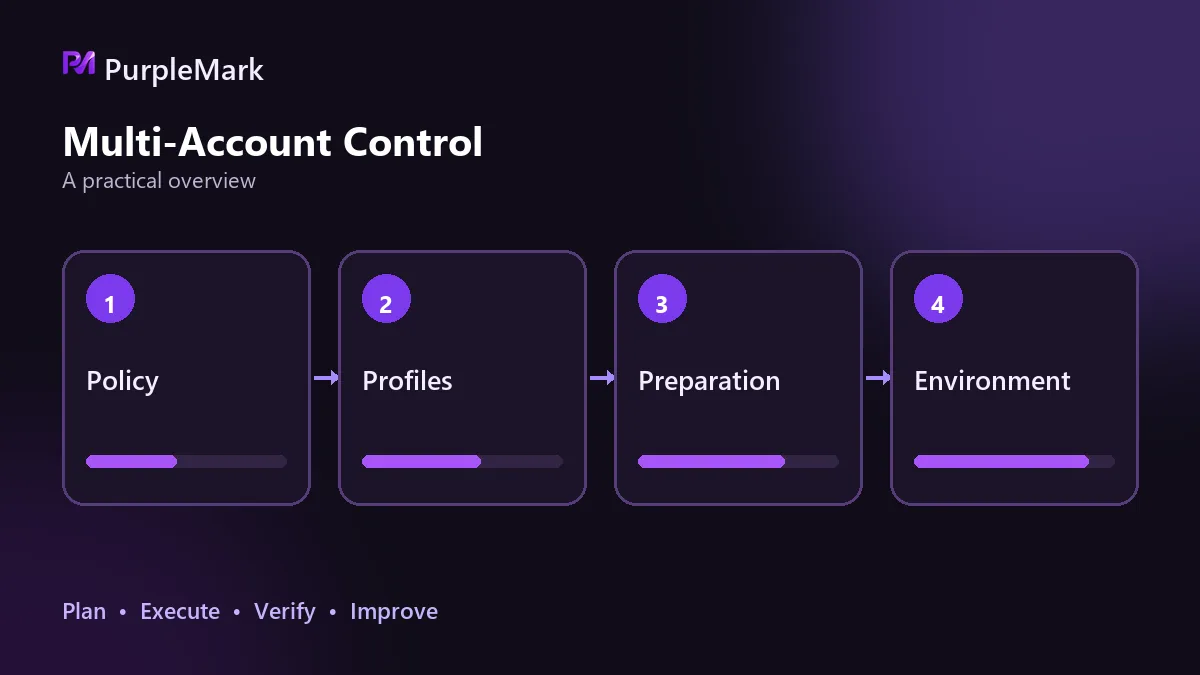
Four legitimate scenarios
Running different markets independently is the most common case. Europe, the United States, and Southeast Asia can differ greatly in price ranges, payment methods, and logistics timelines. One store may not cover all of them well, so operating separate stores with localized content and payment methods for each region is a normal setup.
Multiple stores or sites on the same platform, along with separate operations for different brands, form the second category. Different sites and brands naturally need separate accounting and performance views. Putting everything into one account makes results harder to read and can allow volatility in one brand to affect another.
Separating test accounts from the main account is the third category and is often overlooked. New creatives, landing pages, or campaign structures can first run in a smaller test account and then move to the main account after they are proven. This helps keep trial-and-error from dragging down the main account's data and standing.
Team specialization is the fourth category. Operations, customer service, and media buying can each manage different accounts, with permissions assigned by role and logs showing who changed what and when.
Where platform boundaries are
Most platforms do not categorically prohibit multiple accounts. The key condition is that each account represents a real, verifiable entity and business and is operated independently. How many accounts are allowed and under what conditions depends on each platform's current policies. Rules for cross-site stores and separate brands may also differ, so another company's setup should not be copied blindly.
By contrast, clearly non-compliant practices include duplicating listings on the same site, disguising one entity as several entities, or using accounts to funnel traffic or inflate activity for one another. These are not legitimate multi-account operations; they are violations. Platforms commonly identify similar behavior through device fingerprints. Once operating system, screen resolution, time zone, fonts, and other parameters are collected, it is not difficult to determine whether the same group is operating the accounts. After accounts are linked, consequences can range from reduced reach or ranking to outright suspension.
Three preconditions: miss one and risk increases
The first is truthful information. The registered entity, qualifications, and incoming and outgoing payment methods must match the account. Payment methods deserve particular attention: if several accounts share one card or payment account and one transaction creates a problem, other accounts may be handled together.
The second is environment independence. Each account should have its own login environment and should not share cookies, local storage, network egress, or device fingerprints.
The third is independent compliance. Each account must meet platform rules on its own, including advertising content, product information, and after-sales commitments. A violation on one account should not cause other accounts in the same environment to be pulled into the same problem.
Clearing cookies and switching browsers is not isolation
This is one of the most common misunderstandings. Installing three browsers on the same computer, or clearing cookies before every login, may look separate, but three core facts remain unchanged. Graphics rendering and font lists still reflect the same device; all accounts still leave through the same network egress; and time zone, language, and screen parameters can still be compared across accounts. Once those fields are combined, identifying the same device is not difficult.
What has really been separated is only the cache. If customer service staff rotate through several store backends on one machine, saved credentials and customer order information may remain locally. That is a data-security issue, which is separate from account-linkage detection. Both need to be managed.
The cost of misuse
Buying and aging accounts, operating many accounts in bulk on one device, or using multiple accounts to boost one another rarely affects only one account after detection. Assets tied to the same payment method, environment, page, or pixel may be handled together; account balances and active campaigns can be interrupted at the same time. During an appeal, the operator may first have to explain how those links were created. Recovery usually takes far more effort than building the structure correctly from the beginning.
Implementation requires three layers at once
Effective isolation depends on three layers working together: at the environment layer, each account has an independent environment with stable parameters; at the network layer, each account is bound to an egress that matches its target market; at the management layer, environments can be reused appropriately, permissions are role-based, and operations are logged.
For long-term management of multiple accounts, using PurpleMark to keep each account tied to a fixed environment and egress is one routine way to put these three layers into daily operations.
Return to the two questions at the start: first decide how many accounts the business actually needs; then check whether the setup stands up to the three conditions above. When all three are satisfied, multiple accounts can become an efficiency tool rather than a source of risk.


