
Etsy focuses on original handmade goods and has strict policies that can lead to shop suspensions. This guide covers common beginner pitfalls such as owner details being tied to the payout card, fees, unsupported mainland China bank cards, originality requirements, and one set of registration materials per shop.
Etsy is a creative marketplace focused on handmade, vintage, and uniquely designed products. New sellers often run into problems because they are unfamiliar with the platform's details. Here are the key pitfalls Etsy beginners should avoid so they can operate more smoothly and stay compliant.
Registration and payout pitfalls
The shop owner's details are tied to the payout card and are difficult to change later. When registering on Etsy, the owner's name is linked to the payout card information. In practice, the person whose name and bank card are entered will generally remain the account holder. Before registering, make sure you use genuine, long-term, stable identity and payout information to avoid complications if you later try to change the operating entity.
Choose your payout card with regional restrictions in mind. Bank cards issued in mainland China are generally not accepted as payout accounts, while Hong Kong cards may be accepted. Etsy also generally does not accept PayPal as the payout account, so payouts need to go to a bank card. Prepare a bank card supported by Etsy in advance.
Watch the different fees. Etsy charges several types of fees, including but not limited to a listing fee of about US$0.20, automatic renewal fees, and quantity fees; a transaction fee of about 6.5%; and payment processing fees that vary by country or region (about 3% + US$0.25 in the United States and about 3% + C$0.25 in Canada). Include these costs when setting prices.
Customer support is asynchronous. Etsy does not provide real-time online customer service. Questions must be submitted online, and official replies usually take 1–2 days. Leave enough time to deal with account or order issues instead of waiting until the last minute to ask for help.
Originality and compliance pitfalls
Etsy is positioned as a creative marketplace centered on original handmade products. The platform expects original handmade goods. If a shop sells non-original products, such as identical items already sold on other platforms or elsewhere on Etsy, the shop may be suspended soon after opening.
Disclose production partners truthfully when the product is not entirely original. If an item is not completely original, identify the production or collaboration partner, including the partner's name and country, to reduce the risk of being treated as infringing or non-original.
One set of registration materials should only be used for one shop. Using materials from a failed application or materials that have already been used can lead to shop closure. One set of registration materials should only be used for one shop and must not be reused. Use genuine, self-owned information that has not been reused before.
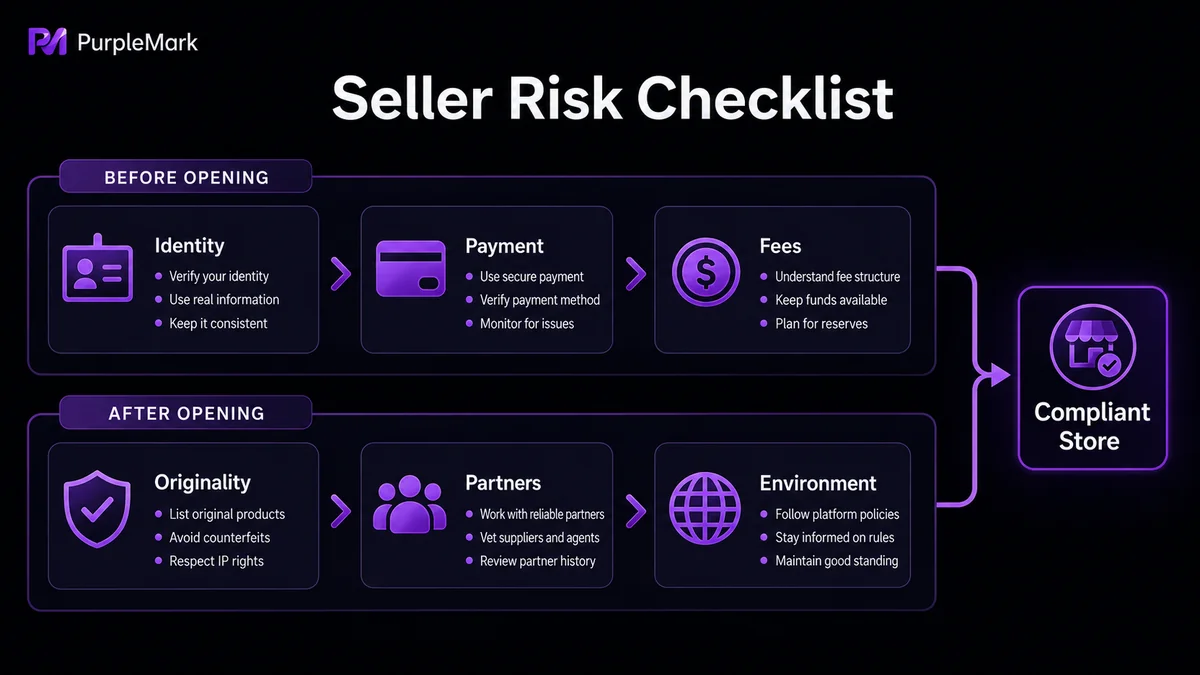
Account stability and compliant operations
Etsy has relatively strict platform policies, and accounts can also be sensitive to the login environment. Sellers in China may sometimes trigger risk controls because of IP or environment issues. The following points are important:
- Keep the login environment stable. Use a consistent device and network that match the region where the shop is operated to access your own Etsy seller account. Avoid unstable environments where the IP changes frequently, such as public Wi-Fi or random proxy nodes, and do not share login credentials with others, which may be misinterpreted as account linkage.
- Use the same operating entity only for compliant shops. Follow Etsy's account and shop policies strictly, operate under a genuine and compliant seller identity, do not reuse registration materials, and do not create fake accounts in bulk.
- Build activity through genuine content rather than artificial boosting. Instead of shortcuts such as reciprocal follows or artificial activity, focus on improving original products, optimizing listing titles and images, and promoting the shop through genuine, compliant channels on and off Etsy.
Compliance reminder: Always follow Etsy's seller policies and intellectual property rules. Operate with a genuine entity and your own original products, and do not try to bypass reviews, reuse registration materials, or use fake reciprocal-engagement tactics, as these can lead to shop suspension and losses.
Frequently asked questions
Can I sell non-original products on Etsy? Etsy focuses on original handmade products, so it is best to sell original or properly authorized items. If an item is not fully original, disclose the relevant partner and country truthfully. Selling non-original identical products already available elsewhere can easily be treated as a violation and lead to shop suspension.
Can I use PayPal for payouts? Etsy generally does not accept PayPal as the payout account and requires a bank card. Bank cards issued in mainland China are generally not accepted, while Hong Kong cards may be accepted.
What should I prepare before opening a shop? Prepare genuine registration information that has not been reused (the shop owner's name should match the payout bank card), a clear direction for original products you can sell, an understanding of listing, transaction, and payment-processing fees, and a bank card supported by Etsy.


