
Want to expand into Japan? This guide explains the amazon.co.jp market, documents and registration steps, monthly fees and referral commissions, plus a product-selection method aligned with Japanese consumer preferences to help you enter Amazon Japan compliantly.
As global e-commerce grows, Japan’s cross-border e-commerce market continues to expand. According to SimilarWeb data cited in the source, amazon.co.jp receives about 570 million visits per month and ranks first in Japan’s online marketplace category. For cross-border sellers targeting Japan, understanding how to open and operate an Amazon Japan store is an important first step.
Overview of Japan’s Cross-Border E-commerce Market
Japan is known for a mature market, strong purchasing power, well-developed digital infrastructure and consumers who are highly accustomed to online shopping.
Besides Amazon Japan, local platform Rakuten also holds a significant share. Compared with Rakuten’s strong localization, Amazon Japan relies on its global network and technology to offer broader selection and a streamlined experience, including a clean interface, one-click purchasing and extra Prime benefits.
Competition is intense, but Amazon Japan has continued to grow. Amazon has invested in logistics centers in Japan to shorten delivery times and improve satisfaction. Its opportunity lies in combining global supply chains with local needs: as demand for international brands grows, Amazon can bring products from around the world to Japan while helping sellers use data and customer analysis to improve targeting, inventory and marketing.
Amazon Japan Store Setup Guide
Documents to Prepare
- Color scan of the company business license showing active status; the Japan marketplace does not accept individual sole proprietors under the described onboarding route;
- Color scan of the legal representative’s ID, clear on both sides and matching the registered account name;
- Credit card enabled for international payments, such as dual-currency VISA or MasterCard; JCB is also accepted in Japan;
- Bank account for receiving payouts; prepare a valid overseas or Hong Kong account if needed to receive JPY;
- Product certifications, trademark registration and other qualification documents required by the category;
- Company name, contact name, a new email address not previously used on Amazon, and phone number;
- Main product categories and marketplaces planned for sale;
- Company background, such as whether you are a factory or own overseas brands.
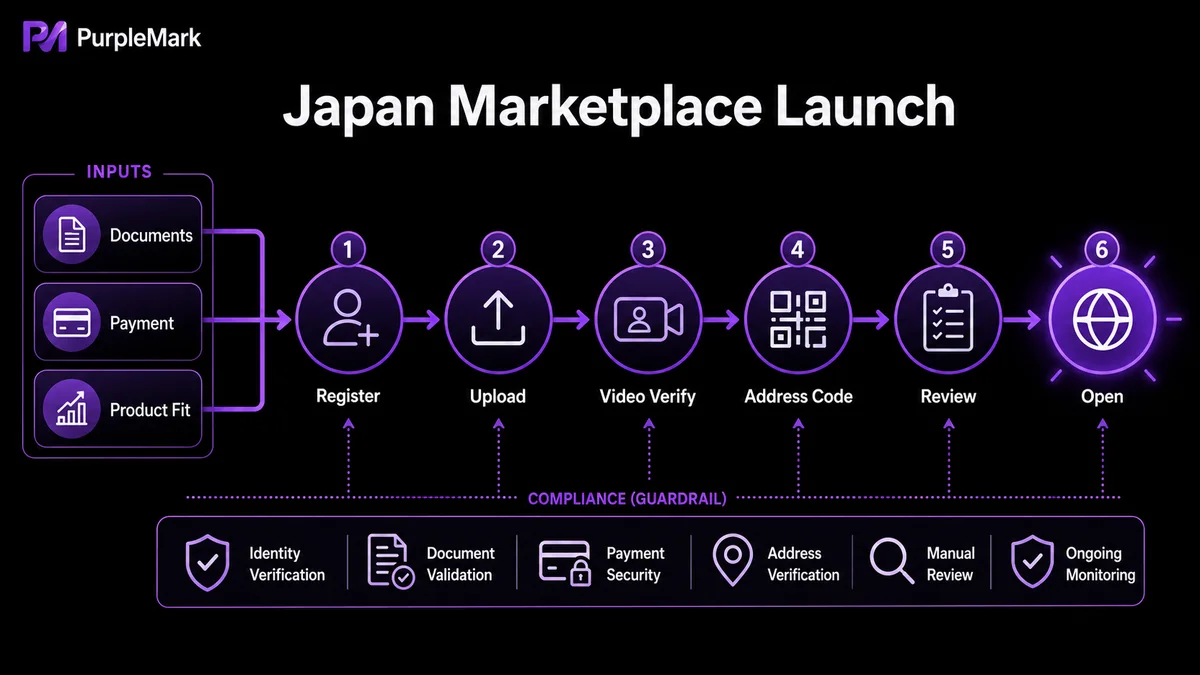
Registration Process
- Go to Amazon Global Selling (gs.amazon.cn) and click the site-registration option in the upper-right corner;
- Select the Japan marketplace and click to create an Amazon account;
- Enter your name and email, set a password, and complete email and phone verification;
- Provide the company’s legal status, contact address, legal representative details, store name and brand qualifications;
- Upload scans of the business license and legal representative’s ID;
- Complete Amazon’s identity verification, which may include an online video call of about 30 minutes;
- After video verification, Amazon may send a postcard with a one-time password to the registered address for address verification;
- After all checks are passed and reviewed, you will receive an email with the store-opening result.
Store Fees
The main costs on Amazon Japan are monthly service fee + referral fee on sales.
- Monthly service fee: the Professional selling plan is JPY 4,900/month; according to the source, no fee is charged for a month with no sales. Chinese sellers operating two or more marketplaces (such as the US, Europe, Japan, Australia, India, Middle East or Singapore) may qualify for a combined multi-marketplace monthly fee cap/discount of USD 39.99 after linking accounts in Seller Central.
- Referral fees: usually 8%–15% by category, with some low-price tiers at 5%. Examples include media 15%; consumer electronics/computers 5% at ≤ JPY 750 and 8% otherwise; beauty and personal care 8%–10%; toys and games 8%–10%; home and kitchen 15%; and eyewear, shoes and backpacks 6%–12%.
Always check Amazon’s latest official fee schedule, as rates vary by category and price tier.
How to Choose Products for Amazon Japan
Before selecting products, study platform rules and Japan’s product-sales regulations. Some special categories, such as medicines and medical devices, may be restricted or prohibited. Then use these strategies:
1. Analyze market demand. Review Amazon Best Sellers, Hot New Releases, Movers & Shakers and similar rankings to identify current demand.
2. Study Japanese consumer preferences. Japanese shoppers often value functionality and quality; one practical feature can materially improve a product’s appeal and sales potential.
3. Localize the product. Adapt both the product and marketing to Japanese expectations and culture. Use natural Japanese in titles and descriptions, and follow local consumer practices and regulations.
4. Track market trends. Watch pop culture, holiday promotions and seasonal changes to identify trending products and demand shifts.
Popular product-category references for Japan:
- Small and lightweight goods: USB humidifiers, portable power banks and similar practical portable items;
- Home products: smart appliances and home décor combining traditional craftsmanship with modern design;
- Anime culture: figures, cosplay clothing, original illustrations and related items with strong local and global fandom demand;
- Health and personal care: health-monitoring devices suited to an aging society, popular beauty devices and skincare products;
- High-tech products: wireless earphones, smartwatches and similar devices;
- Local-style products: Japanese tea sets and Japanese-inspired apparel, popular domestically and also suitable for global sales.
Compliance Notes for Selling on Amazon Japan
There are several important points to remember when entering the Japanese market.
First, follow the single-account principle. Amazon states that one person or seller entity should generally maintain only one seller account unless there is a legitimate business need permitted by policy. Do not create multiple stores without a compliant basis, and do not mass-register false stores for so-called “store clusters.” Register and operate using your real, lawful seller identity.
Second, keep the login environment stable. Amazon may use browser-fingerprint and other signals to identify account environments. Use stable devices and networks appropriate to your operating region, avoid internet cafés, public Wi-Fi and frequently changing VPS environments, and do not share login credentials with others. This reduces the risk of mistaken association or security issues.
If one legitimate company operates multiple Amazon marketplaces, such as Japan and the US, this is a permitted multi-marketplace model for the same entity. You can link marketplace accounts in Seller Central where applicable, manage them in a unified and stable team environment, define clear roles and retain operation logs for handover and audit. Environment-management tools such as PurpleMark can help legitimate teams create fixed browser workspaces for different marketplaces and operators, isolate data and retain operation records.
Compliance reminder: every account must be registered to a real, compliant entity and operated in accordance with Amazon seller-account and store policies. Do not use any method intended to bypass platform account-management or review rules.
Frequently Asked Questions
What is the Amazon Japan market like? It is active and highly competitive, with many loyal customers with strong purchasing power. Consumers value quality and tend to adopt new technology and trends quickly. Competition from domestic and international brands is strong, but new sellers can still find opportunities.
How do I register a seller account for Japan? Visit Amazon Japan Seller Central, choose to create a new account, enter the required company, personal, payment and tax information, complete verification, and then configure your store to begin selling.
What logistics services does Amazon provide? Amazon offers FBA (Fulfillment by Amazon), allowing sellers to send inventory to Amazon warehouses for storage, packing, shipping and customer service. Sellers may also fulfill orders themselves.


