
With fierce competition in Europe and North America, more exporters are turning their attention to the Middle East. This guide helps you first decide whether the market fits your business, then reviews promising product categories and maps out practical routes through trade shows, independent websites, B2B platforms, social media, and Google-based prospecting.
Although European and North American markets are mature, their barriers to entry are high and competition is intense, so many exporters are shifting their attention to the Middle East. The region has solid purchasing power and relies heavily on imported consumer goods, so opportunities do exist. But “there is an opportunity” does not mean “it is easy to do business.” Understanding the market before acting can save you many detours.
First decide: Is the Middle East market right for you?
The Middle East broadly includes around twenty countries such as Iran, Kuwait, and Saudi Arabia. Oil resources support relatively strong purchasing power, while local manufacturing is comparatively limited. A large share of consumer goods is imported, and demand for Chinese products has remained substantial. Major imports include light industrial goods, daily-use products, electronics, and apparel, generally in low-to-mid price ranges, with both made-to-order and ready-stock trading common.
The region also has clear characteristics: policies, languages, and consumer habits vary greatly between countries, while logistics and payment environments differ from Europe and North America. So do not treat it as one unified market. It is usually better to select one or two target countries for deeper research rather than trying to cover the whole region from the start.
Which product categories have more potential locally?
Product selection is especially important when entering the Middle East. The categories below generally have underlying demand, but you still need to validate them against your own supply chain and local market conditions:
- Small home appliances: Family ties are strong, multigenerational households are common, and food culture is important, supporting steady demand for kitchen and household appliances.
- Mother and baby products: Birth rates are relatively high in the region, creating room for maternity, baby, and childcare categories.
- Electronics and drones: Young consumers show strong demand for new electronic devices and wireless communications, while drones and other smart hardware are popular in some areas.
- Beauty and skincare: Consumers often place strong emphasis on eye and brow makeup, making beauty products popular, but cultural expectations and ingredient compliance must be considered.
- Apparel and accessories: Traditional garments such as robes have stable demand, while sellers also need to respect local dress norms and cultural practices.
- Tea and tea ware, LED lighting: Tea consumption is high in some countries, and LED lighting also represents a meaningful export category.
Before deciding whether a category is worth pursuing, validate demand with real data such as keyword search volume, platform sales, and competitor activity, then decide what to stock.
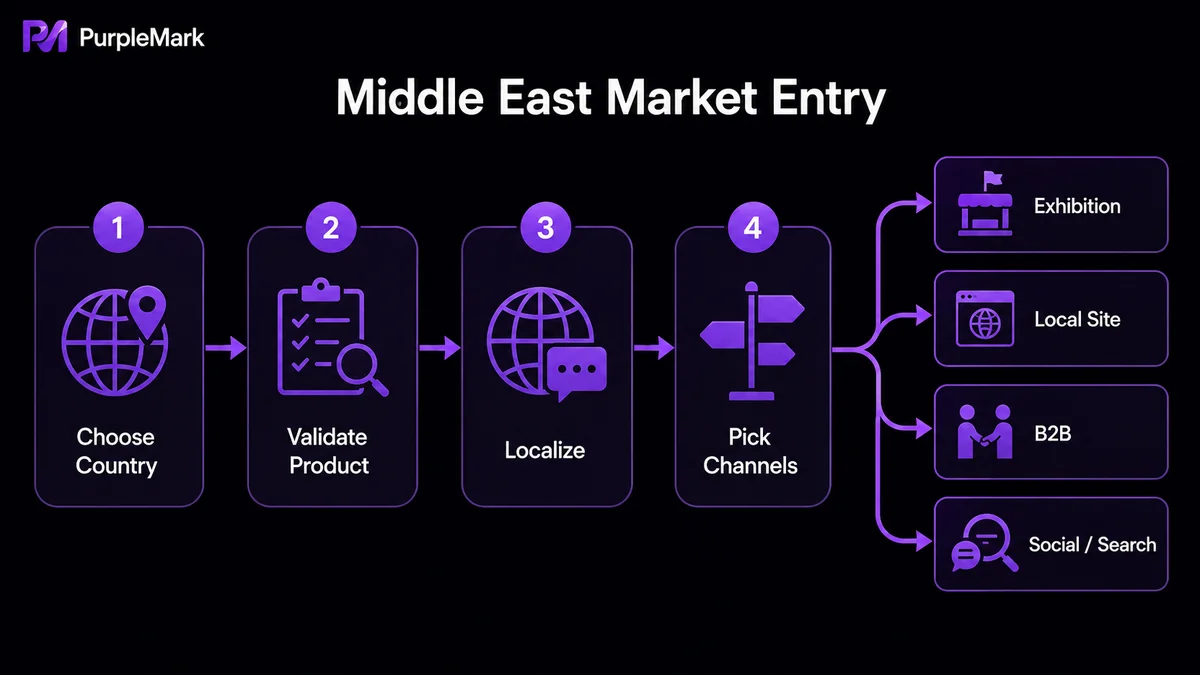
Practical ways to develop customers in the Middle East
You do not need to use every channel. Choosing two or three and developing them consistently is usually more effective.
Trade shows and offline networking
Dubai is a major transportation hub and goods distribution center in the Middle East, with many shipments transiting through it. Attending local trade shows lets you meet customers face to face and learn about real demand, making it a direct way to evaluate the market and a good option for teams ready to invest seriously.
Build an Arabic-focused independent website
Many Middle Eastern customers search in Arabic. Build a website on your own domain, localize content around target keywords, and work on SEO so potential customers can find you proactively. This is more sustainable than simply waiting for inquiries.
Make good use of B2B platforms
The Middle East has local B2B platforms such as Tradekey. You can publish products there, add images from multiple angles, explain selling points clearly, and use keyword analysis tools to evaluate search interest before maintaining listings consistently.
Proactively find customers through social media and search engines
Many Middle Eastern trading companies look for suppliers on LinkedIn and Facebook, so you can target wholesalers and intermediaries. Location searches on Google Maps can also help you identify relevant businesses in target cities and obtain contact information.
One point is worth noting: using LinkedIn and Facebook for customer development often means maintaining multiple accounts and interacting continuously. As the number of accounts grows, management can become messy and accounts may be misjudged more easily. If social-media prospecting will become a routine part of your work, you can keep these accounts in separately managed browser environments. PurpleMark supports independent environments and grouping for different business accounts, making it easier to organize them by customer or region. For repetitive actions such as liking, browsing, and adding contacts, automation capabilities can also reduce repetitive manual work so you can focus on conversations that actually require judgment.
Reminder: Whether you prospect through trade shows, social media, or search, respect local trade rules and platform policies. Multi-account social-media operations should be based on managing your own compliant accounts and should avoid bulk, nuisance-style outreach.
Conclusion
The Middle East offers opportunities, but it is better suited to “choosing a few points and going deep” than trying to “cover everything at once.” Start by selecting target countries, validate product demand, then choose the routes that fit you best among trade shows, independent websites, B2B platforms, and social media. Treat it as a long-term market that requires patient development; that approach is often more likely to lead to deals than rushing for quick results.


