
Cross-border logistics is not just about “sending goods out”, it directly affects buyer experience and repurchase. Facing postal services, dedicated lines, overseas warehouses, international express delivery and various logistics platforms, sellers are often confused. This article explains the characteristics, suitable scenarios and pitfalls of each solution category by category to help you create a logistics combination that suits you.
When doing cross-border e-commerce, logistics is often a key factor that determines whether buyers will repurchase. If the goods arrive quickly and stably, the customer experience will be good; on the contrary, a poor receiving experience may prevent repurchase. But when faced with postal services, dedicated lines, overseas warehouses, international express delivery and a bunch of logistics platforms, many sellers are spoiled for choice. This article helps you sort out the mainstream solutions one by one.
1. Postal parcel
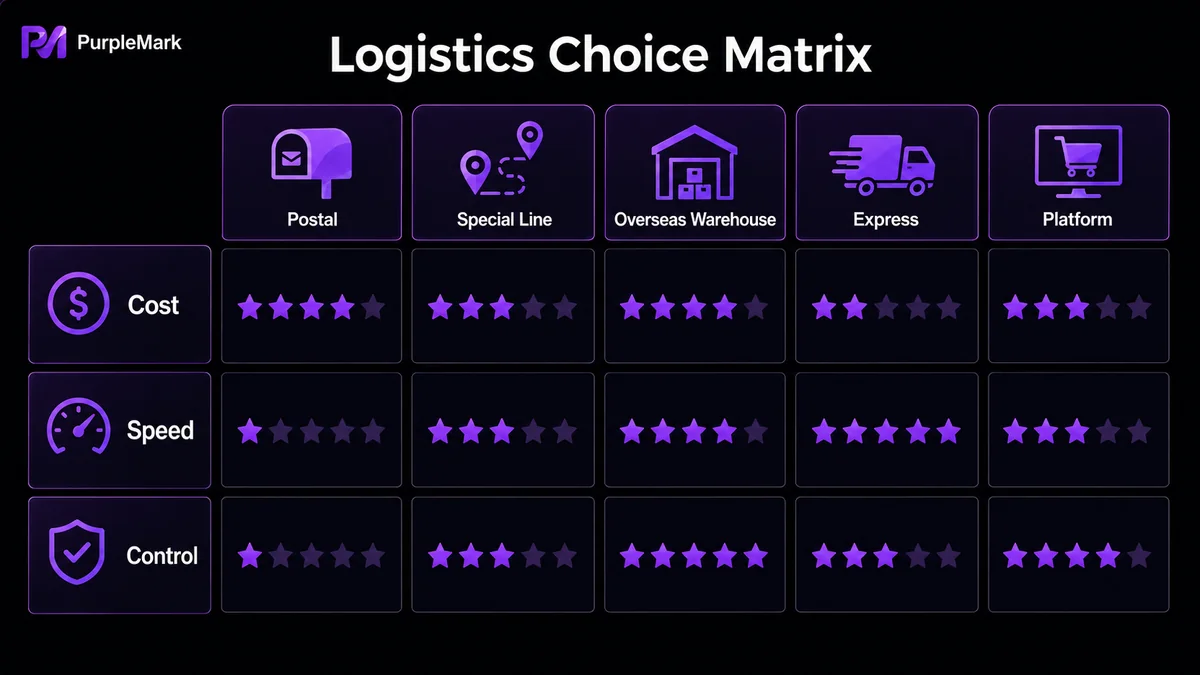
The core selling points of international small parcels in the postal system are cheapest + wide coverage. Representative channels include China Post, Hong Kong Post, Singapore Post, etc., and can be sent to most countries in the world.
- Applicable: Distribution-type sellers with small items within 2kg, low unit price and thin gross profit, especially to markets that are not sensitive to timeliness such as South America and Eastern Europe.
- Note: The packet loss rate is relatively high and the after-sales cycle is long. It is not suitable for high-value or time-sensitive products. You can rely on platform protection or low-cost logistics insurance to cover your expenses.
2. Cross-border dedicated line logistics
The dedicated line is built by a third-party company to connect trunk transportation, customs clearance and terminal delivery. It is faster than postal services and cheaper than express delivery and is currently the default choice for most sellers. Representatives include Yanwen, Shunyou, Di Sifang, Yuntu, etc.
- Applicable: Sellers who operate on multiple platforms (Amazon FBM, eBay, Wish, etc.), have a certain scale, and need stable customs clearance and delivery rates.
- Highlights: Can carry special goods such as live electricity, liquids, cosmetics, etc., and some routes support European VAT customs clearance.
- Note: Customs clearance policies will change, so please pay attention; although the timeliness is better than that of postal services, customers still have to give reasonable expectations.
3. Overseas warehouse
Stocking goods in advance in overseas warehouses in the target market and shipping them locally as soon as the order comes is the most direct way to improve the delivery experience. It is also the key to localized fulfillment for many medium and large sellers.
- Applicable: Sellers with stable hot-selling SKUs and accurate sales forecasts are especially suitable for FBM local shipments or independent warehouses.
- Advantages: fast delivery (usually 1–3 days), reduced return costs, and support for local customer service and after-sales.
- Difficulty: It has high requirements on inventory turnover and forecasting. It requires pre-stocking and depositing funds. It is not suitable for categories with many SKUs and frequent changes.
4. International Express
Giants such as DHL, UPS, and FedEx provide global standardized distribution with stable customs clearance, high efficiency, and reliable compensation, but at a high price.
- Applicable: high value-added goods, sample delivery, B2B trade, or brand sellers that emphasize service reputation.
- Judgment: It is worth using express delivery for products with high value, tight time, and fear of loss and damage; it is not cost-effective to use express delivery for daily products with low profits.
5. Third-party logistics integration platform
SaaS such as ShipStation, AfterShip, 17TRACK, Sendcloud, and Easyship integrate order capture, ordering, tracking and shipping rules for multiple platforms and multiple stores into one system.
- Applicable: Teams that operate multiple stores/platforms at the same time, use multiple logistics providers, and want to manage shipments in a unified manner.
- Value: Save labor, unified tracking, faster customer service response, and more timely exception handling.
6. Emerging intelligent logistics platform
Platforms like Globy.com integrate logistics providers, customs clearance and overseas warehouse resources, use intelligent routing to help you automatically recommend channels, generate customs clearance documents and visualize tracking, focusing on "one-stop".
- Applicable: Independent website light operation sellers, or individuals or small teams who don’t know much about logistics and want to get it done with one click.
- Note: It is true that a low threshold saves trouble, but some complex orders may still require manual intervention, so don't rely too much on the system.
Don’t ignore the “multi-account” operational difficulties behind logistics
When logistics is implemented, the real headache for many sellers is not "which logistics provider to choose", but the coordination of multiple platforms and multiple accounts:
- Orders are prone to chaos: At the same time, when deploying Amazon, eBay, Shopee, and independent sites, the data interfaces, order structures, and timeliness requirements of each platform are different. It is easy to make mistakes and miss delivery if it is all manual. If the tracking number is uploaded slowly, it may be judged by the platform and affect the logistics score.
- Logistics provider docking is cumbersome: Different logistics providers have their own systems and rules, and it takes time to compare prices, customs clearance documents, order templates, and track synchronization.
- Multiple accounts are at risk of being risk controlled: If multiple platform accounts are squeezed in to log in in the same browser environment, the platform will identify "one person with multiple accounts" through IP, device fingerprints, and cookies, thereby triggering risk control and affecting logistics account binding.
For these situations, a pragmatic approach is to use Fingerprint Browser to provide an isolated and independent login environment for different e-commerce accounts, so that each account is not technically related to each other, and can also be bound to their respective logistics service provider accounts. When necessary, cooperate with the platform API to perform automated operations such as batch ordering and tracking number synchronization. Only by taking care of both the account and logistics aspects can the delivery process be stable.
Summary
There is no "best" in logistics, only "the most suitable": for small items, use the postal service, for mainstream goods, use dedicated lines, for localized experience, use overseas warehouses, for high-value goods, express delivery, and for complex operations, add an integrated platform. First, pick out a set of combination plans based on your own category, scale and target market, and then straighten out the coordination between multiple accounts and the logistics system - you will win most of the logistics aspect.


