
AFD sells the traffic a domain brings in; RSOC sells the search intent content draws out. From the mechanism difference to tighter policy and user-experience pressure, and what higher barriers mean for operators, without going into specific campaign tactics.
The most visible change in search arbitrage over the past two years is that AFD revenue has slid steadily while RSOC has become the new main stage. Both rest on the same thing, trading bought traffic for search advertising revenue, but their mechanisms differ a lot, and once that difference is sorted out, many of the symptoms explain themselves.
Aligning the two acronyms first
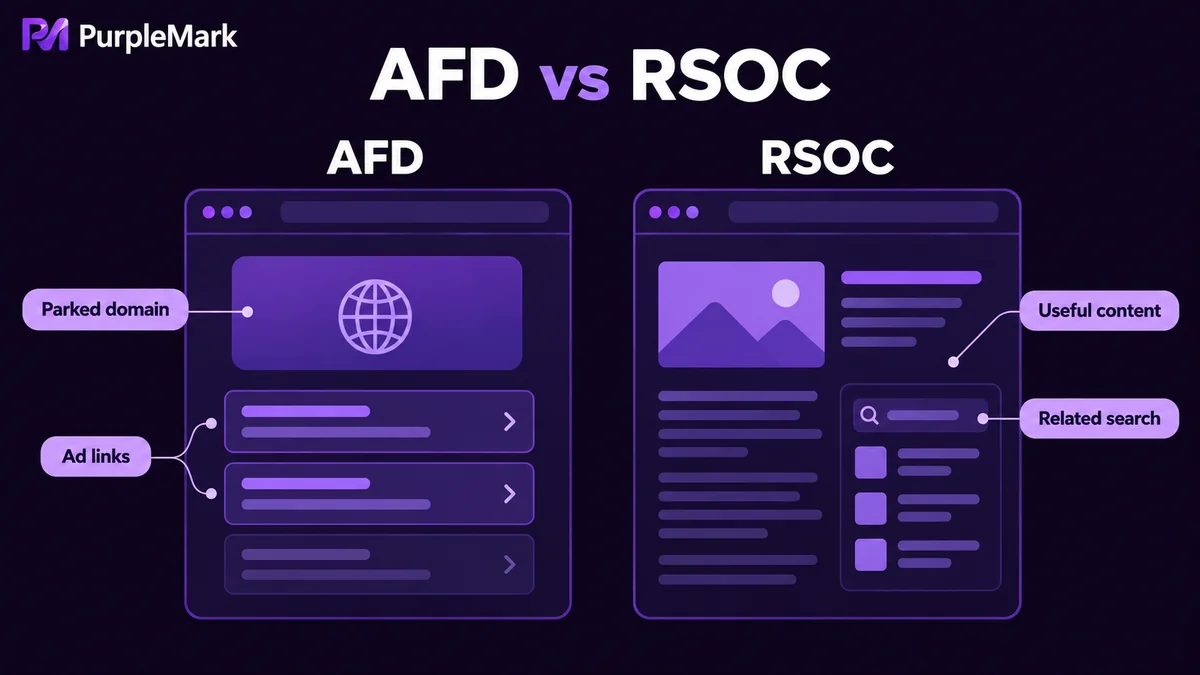
AFD refers to the domain parking advertising setup: you hold a domain but produce no content, the page is handed to an ad system to fill, and users arrive from search, direct typing, or referral traffic, so ad impressions generate revenue.
RSOC refers to the related search unit on a content page: a set of related search terms is embedded in the article, the reader clicks one, lands on a search results page, and the ads at that step are the source of revenue.
In one sentence: AFD sells the traffic a domain carries with it, while RSOC sells the search intent content draws out.
Several reasons AFD is receding
The chain is too short. There is nothing on a parked page but ads, users take one glance and leave, and there is very little to optimize. Everyone's approach converges, so in the end it comes down to who can buy traffic more cheaply.
The traffic source is unstable. This business once leaned heavily on cheap traffic from content recommendation platforms, with large volume and a low unit price, but the moment platform policy shifts, the traffic mix and cost change right away. Living off a single source means naturally weak resistance to risk.
Policy and compliance tighten. Search engines have narrowed ad delivery on parked domains year by year, with increasingly detailed requirements on traffic quality, ad placement, and click behavior. Once accidental clicks, induced clicks, or obviously unnatural traffic are identified, the usual outcomes are rejection, withheld payment, or even a ban, and these are hard to avoid entirely in rough-and-ready campaigns.
Unit prices get squeezed thin. There are too many sites of the same kind, advertiser budgets are limited, and revenue per impression naturally drifts down.
Why RSOC is seen as the replacement
RSOC revenue comes from search ads, whose unit price is inherently higher than ordinary display ads; more crucially, it can build context. The topic of the content page decides which terms appear in the related search unit, the people who click through carry clear intent, and the conversion experience on the advertiser side is somewhat better.
The cost is that the barrier shifts from being able to buy traffic to being able to make content. The related search unit sits under a real article, so the page has to have something to read; search terms and page topic have to match; the layout cannot be made to mislead people the way an on-site search box does. If these points are not handled well, the short-term numbers may still look fine, but problems are certain over the long run.
Pressure from both policy and experience
On the policy side, search advertising has explicit terms for publishers, and the definitions of induced clicks, misleading layout, and unnatural traffic keep getting finer. However strong your tracking and optimization tools are, they only optimize efficiency; they cannot substitute for compliance.
On the experience side the pressure is more direct. If a related search unit looks too much like content, readers will click it as if it were on-site search, and once the accidental-click rate runs high, traffic quality metrics look bad and both unit price and stability suffer. Problems of this kind show up in revenue with a delay, and by the time you see them, the loss has already been accumulating for a while.
What it means for operators
The barrier is higher. The old logic, buy cheap traffic, put up a page, and it runs, now requires at least three things to be filled in: continuously producing readable content, tracking behavior after the click, and building compliance requirements into the process rather than patching them up afterward.
Content quality has gone from a bonus to a hard threshold. A page with no content, or terms that do not match the topic, will produce bad numbers, and bad in a structural way that price adjustments cannot fix.
The room for rough-and-ready campaigns has been compressed. Watching cost per click alone is no longer enough; you have to look at dwell time after the click, secondary behavior, and feedback on the advertiser side. If these metrics look bad, even the cheapest traffic is meaningless.
For people running several ad accounts and several sites at once, environment management becomes a daily problem: login states, Cookie, and verification information get mixed together, and one misstep can implicate the whole account pool. In scenarios like this, PurpleMark provides environment isolation, letting different accounts run in their own separate environments.
A pragmatic judgment
For people who already have content production capacity and stable sites, RSOC is worth studying; for those who have only heard that AFD used to be easy and want to find a new opening, first think clearly about whether you can keep producing content and whether you can accept a longer payback period. Any claim of stable, high returns deserves a few more questions.


