
Affiliate promotion for audiobook subscriptions uses a very different revenue model from one-time products. Understand how commissions are calculated, which channels fit, and which terms can get you into trouble before you start.
Affiliate promotion for products such as audiobooks, streaming services, and software subscriptions works very differently from promoting one-time purchases. Many people use a “sell one, earn one” mindset, then wonder why plenty of clicks produce little income. The problem is usually a poor understanding of the commission model.
Revenue is based on subscriptions, not clicks
For audiobook subscription programs, a conversion is usually counted only when a user completes a free trial or starts a paid membership for the first time. Clicking a link or merely creating an account usually does not count, although some programs pay a small amount for completed registrations; that amount is far below the payout for a subscription conversion.
Commissions are generally tiered by subscription type. A free-trial conversion, a monthly membership, and an annual membership are three different tiers, and annual subscriptions usually pay more than monthly ones. Some programs also pay according to how long a user remains subscribed. If the user cancels midway, later commissions stop.
That last point is easy to miss: your revenue depends not only on how many people you bring in, but also on how many stay. The goal is therefore not to maximize clicks, but to attract the right people.
How to choose content and channels
Promoting a single book directly often converts only moderately because the user may not have an immediate need. It works better to place the product in a concrete scenario: what to listen to during a commute, how to build a reading habit when time is limited, or which books to hear first when entering a field. The user is not really trying to buy an audiobook; they are trying to solve the problem of having too little time to read.
Book lists and rankings naturally fit search traffic and can be reused over time, but they need selection criteria and a clear explanation of why those titles were chosen. A list with no reasoning usually converts poorly.
The sign-up path also needs to be explained clearly. For subscription products, the main conversion entry point is often a free trial, so the content should state what the trial includes, how billing works after it ends, and how to cancel. Explaining cancellation proactively can actually improve conversion because users often worry about forgetting to cancel and being charged.
For channels, long-form websites are suited to building SEO traffic, video and short video are good for fast exposure, forum Q&A can capture highly specific questions, and email lists are useful for repeated contact with the same audience. Reusing the same core material across channels is common, but each channel account should remain independent and stable. Mixing accounts in the same environment can create links between them, so a problem on one channel may affect others. PurpleMark provides support for this layer of environment isolation.
Three policy red lines that are easy to cross
The first is self-referral. Ordering through your own affiliate link, or asking family and friends to buy on your behalf to generate commission, is explicitly prohibited by almost all affiliate programs. If discovered, the usual result is removal from the program and forfeited commissions.
The second is traffic sources. Program terms usually restrict permitted promotion methods. Bulk email, direct bidding on branded keywords in paid search, or posting links on coupon sites are prohibited by many programs. Before going live, confirm that your planned promotion method is allowed.
The third is trademark use. Brand names and trademarks should not be placed in domain names or account names, and ads must not make users think you are the official brand or have authorization when you do not. You can mention a brand as a product name in the body text, but you should not present yourself as an official storefront.
In addition, no program allows you to promise earnings in your content.
Which numbers should you track?
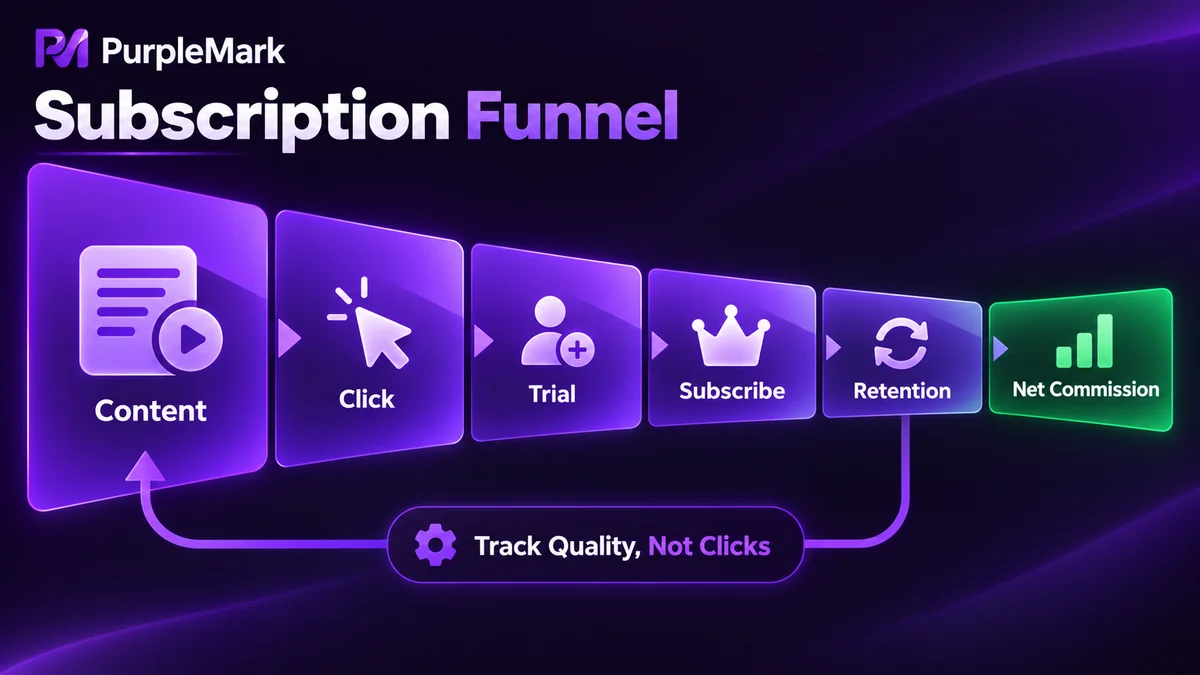
The funnel is: click, reach the trial page, start the trial, complete a subscription, remain subscribed. Useful metrics include the number of completed subscriptions driven by each piece of content, retention among those users, and net commissions after refunds and reversals. Looking only at clicks and registrations can be misleading because a free registration is not the same as a paid subscription.
The right order for getting started
Start with one narrow topic instead of trying to cover everything. Build five to ten pieces of content before adding affiliate links; doing it in the opposite order can lead to rejection during review. Publish consistently for one to two months, observe which topics generate the most subscriptions, then scale the strongest directions and reduce effort elsewhere.
Subscription affiliate programs pay for users who stay, not simply for units sold. Your content should focus on finding people who genuinely need the product.
This content explains affiliate marketing methods only and does not promise earnings. Specific commission rules are subject to the official terms of each affiliate program.


