
Just starting to optimize an independent e-commerce site and not sure where to begin with all the available tools? This article groups them into three use cases—site diagnostics and optimization, competitor analysis, and outreach email marketing—and explains what each category should help you solve so you can choose only what you need.
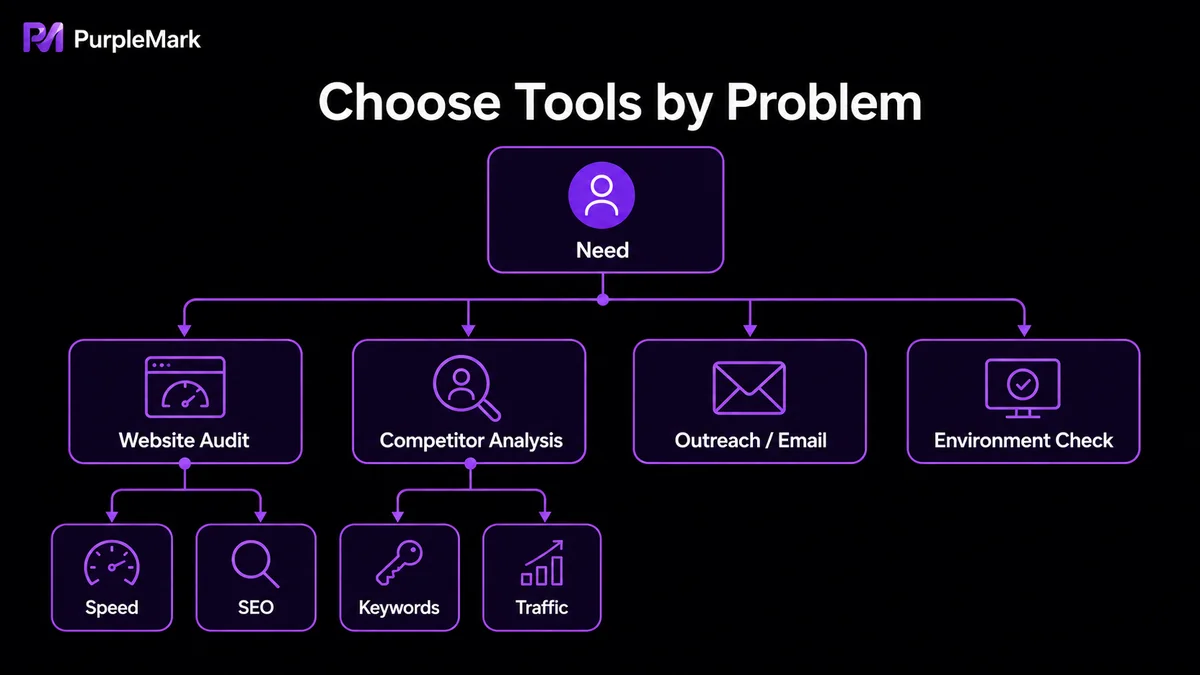
Running an independent e-commerce site is not only about building it. The ongoing work after launch—growing traffic, improving rankings, and following up with customers—can be just as challenging. One of the most common beginner mistakes is buying a pile of tools right away and then barely using any of them. A better approach is to choose tools by purpose: first identify the problem you need to solve now, then pick the tool that fits it. This guide organizes commonly used tools into three use cases.
1. Website diagnostics and optimization
This category answers the question: “How is my site actually performing, and what should I improve?”
- Google Analytics: Google’s free traffic analytics tool. It collects traffic data so you can see where users come from and what they do on your pages, helping you optimize the site and conversion paths more precisely.
- Google Search Console: Measures your site’s search performance and rankings and can help uncover technical issues. It is close to essential for SEO.
- WooRank: A web-based SEO analysis tool that scores a site based on content, traffic, domain factors, and more, then provides specific improvement suggestions. It is useful for a quick health check.
- Semrush: A broad platform that covers SEO, search advertising (PPC), social media, and content marketing. It is a more advanced option for people who want one suite to handle multiple functions.
- PR Posting: Helps increase website traffic and brand awareness by distributing content to selected regions, with support for the United States, the United Kingdom, the European Union, and more than 170 countries and regions.
2. Competitor analysis
This category answers: “Why is a competitor ranking ahead of me, and what can I learn from them?”
- Ahrefs: A widely used SEO tool for link building, keyword research, competitor analysis, rank tracking, and site audits.
- MOZ / Opensiteexplorer: Helps you understand why a page ranks where it does by examining inbound links and lets you compare backlink profiles with competitors. Opensiteexplorer focuses specifically on backlink data.
- Majestic: A powerful backlink data mining tool that shows link volume, sources, types, and quality, making it useful for studying a site’s backlink ecosystem.
- Wholesale Central: A B2B website that can connect you with verified wholesalers, importers, distributors, and manufacturers, helping you study a customer’s supply chain and sourcing channels.
3. Outreach emails and email marketing
This category addresses: “Once I have a customer lead, how do I keep following up and turn it into a conversion?”
- Saleshandy: A sales email tracking and marketing automation tool that helps you follow up on outreach emails and see whether and when recipients opened them.
- Cirrus Insight: Focused more on sales management and marketing automation. It can integrate smoothly with an existing email client so you can work directly from your usual inbox.
- Good Email Copy: A collection of professional email templates from well-known companies, covering scenarios such as email confirmation, thank-you notes, product feedback, holiday greetings, trial expiration, account upgrades, and invitations. When you are stuck on copy, you can use these as references and adapt them.
An often-overlooked “environment” issue
If you run multiple sites or multiple accounts at the same time—for example, several stores or several promotional channels—SEO tools often require you to log in to separate accounts. Using isolated browser environments to manage those accounts separately can help avoid having them identified as connected. You can also install the relevant SEO or analytics extensions through an app center, making data collection and analysis smoother within the same workflow.
Summary
Tools should serve your goals. First decide whether you are trying to “diagnose and optimize,” “research competitors,” or “follow up with customers,” then learn one or two suitable tools well. That is much more efficient than collecting a large set of overlapping tools. Start with a few of the options above and you will have a practical foundation for optimizing your independent site.


