
After three years, the biggest impact on earnings came not from tricks but from a few basic judgments: where to focus in the first six months, when to stop a direction, which metrics actually drive revenue, and which mistakes to avoid.
Three years is not a long time, but it is long enough to overturn a few assumptions. When I started, I had experience with paid acquisition and knew a little about supply chains. I thought I could scale by adding budget, but the money went out faster than the returns came in. Only after I gradually shifted toward organic traffic from content did income become stable.
Looking back, the biggest difference did not come from any single tactic. It came from a few judgments: what direction to choose, when to stop, which numbers to watch, and how to maintain accounts and environments as long-term assets.
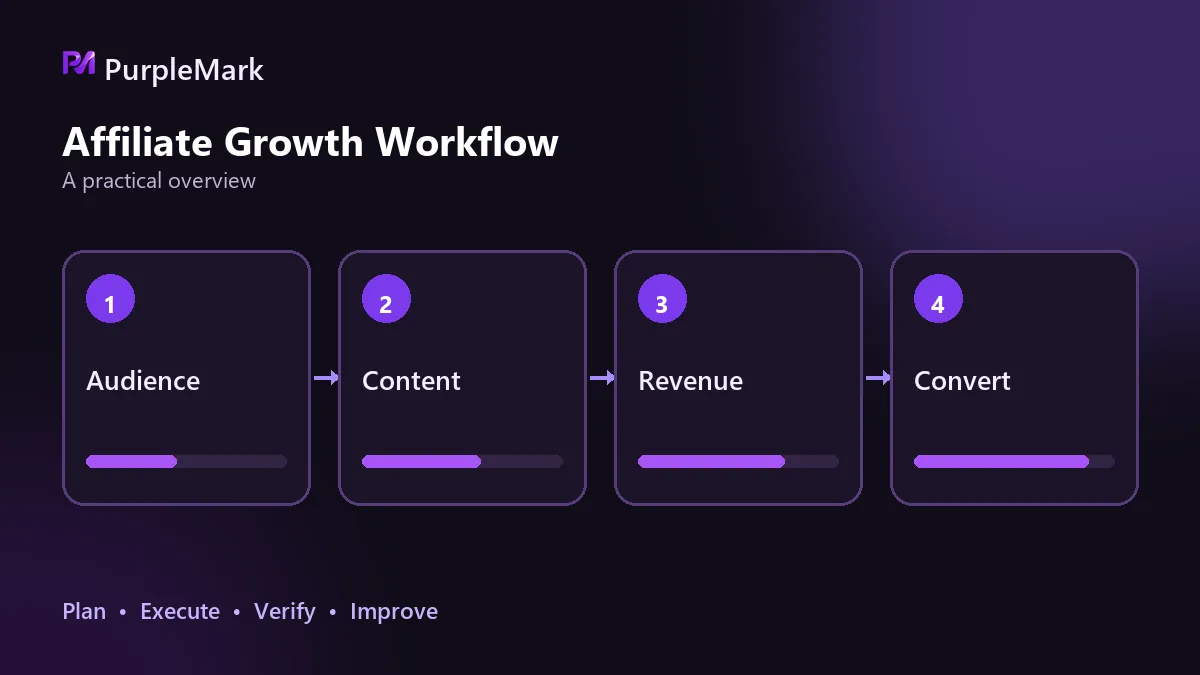
Where to focus in the first six months
Beginners often spend their first six months hunting for a secret formula. In practice, there are two things that matter most during this period: choose a vertical and choose a traffic model.
The vertical determines how everything that follows will be written. The criteria can be simple: Is demand stable? Is competition still manageable? Can you keep producing content in this field? A market with steady demand does not depend on trends, so the publishing rhythm is easier to control. Lower competition also means a small account still has a chance to be seen. One direction that worked for me did so precisely because demand had existed for a long time and there were not yet too many competitors.
The traffic model answers one question: where will the first users come from? Search engines, social media, and paid advertising require completely different skills, so in the first six months it is better to make one path work before adding another. Someone with advertising experience may want to buy traffic immediately, but at that point conversion rate, creative direction, and target audience are all still unknown. Spending on ads is simply paying to test a hypothesis.
Startup costs can be kept very low. Public tutorials and videos are enough to learn the basics, and industry groups can help with many details. For testing, start with low-barrier, small-task offers, keep the budget for each ad extremely small, and stop after three days if there is no effect before moving to the next one. Many small tests work better than one large bet.
When to give up on a direction
This needs to be judged at two levels. Many people mix them together, so they keep weak tests running too long and stop promising directions too early.
The first level is an individual test. For one creative or one offer, a window of three days to one or two weeks is usually enough. Watch whether basic metrics such as click-through rate and cost per conversion are moving. If nothing changes after more than half a month, the combination probably does not work. Stop it rather than continuing just because the commission is high or someone else is succeeding with it.
The second level is the vertical itself. Here, the first few months of revenue are not enough to judge the result. Content accumulates over time, and earning almost nothing in the first half year can be normal. Published material is still being searched and cited even if it has not started converting. The right questions are whether the data is moving and whether you can explain why conversions are not happening, not whether the short-term revenue looks good. A direction whose problem cannot be explained may be worth replacing; a direction whose problem is understood but whose timing has not arrived may deserve more time.
What stops most people is the transition between the first six months and the first year: the investment is already meaningful, but returns have not appeared. Quitting there also throws away the understanding built during the earlier months.
Which metrics in the data determine earnings
Commission rate gets the most attention but often matters the least on its own. Earnings are the product of commission rate, average order value, and conversion rate. If any one of them is near zero, the result is also near zero. A product with a high commission rate but a low order value and poor conversion will not make money even with large traffic volume.
So the order for reading the data should be reversed: look at conversion rate first, then average order value, and commission rate last. Conversion rate tells you whether the path works at all. Average order value determines how much each order is worth. Commission rate fine-tunes the result after those two are working.
There are also several less obvious but critical metrics. First, can payouts actually be completed? If the payment chain does not work, the number shown on the dashboard means nothing. Second, how stable are the account and ad account? Stronger, more established accounts can have noticeably lower advertising costs, and that difference ends up in profit. Third, look at revenue per piece of content. It shows whether audience trust is accumulating. The number may not look meaningful at small scale, but after two or three years the gap can be large.
Three kinds of mistakes I made
Expanding too broadly
For a while, every new high-commission product looked worth testing. I changed direction seven or eight times in one year. Each area only received surface-level work, so the content never accumulated and the audience never stayed. Broad expansion is really a way of slicing limited time into pieces until none of them is deep enough. Later I limited myself to one or two fields I genuinely understood and kept working on them. The same readers began converting repeatedly, and revenue per piece of content finally rose.
Chasing high commissions and ignoring conversion
Commission rate used to be my first product-selection criterion. If the number was high, I assumed the product was worth promoting. I then promoted two high-commission products that received plenty of traffic but almost no conversions. The reason is easy to understand: high commissions often come with a low order value or intense competition, while users still have weak motivation to buy. Later I changed the order of evaluation: first ask whether the product solves a clear problem, then look at the revenue structure, and only then look at commission rate.
Relying on a single traffic source
At one point I put all my effort into one channel. When traffic flowed, earnings were strong; when the platform changed its rules, income fell straight to zero. There is an opposite mistake too: opening three channels at once, working only shallowly on each, and getting none of them to stable results. A steadier rhythm is to make one channel work first, add the next only after conversions are stable, usually start with content because it can be reused, then add distribution channels, and leave paid acquisition until last.
Maintain accounts and environments as assets
Early on, I used the same browser to switch among accounts on different platforms and assumed there would be no problem as long as I did not break the rules. Later one platform restricted an account, and another platform immediately started asking for verification. The problem came from overlapping environments being treated as related.
The fix was to give each account its own fixed environment, without sharing fingerprint parameters or network exits, and keep that setup unchanged over time. Changing computers or operators does not change the account-to-environment mapping. Tools such as PurpleMark are designed to keep that mapping fixed so daily work does not require constant logging out and back in.
The investment is small, but without it the content and audience trust accumulated earlier can disappear overnight. One account that can be used for three years is worth far more than three accounts that only last one year.
Looking back
If these three years had to be reduced to three sentences: choose products for conversion, not commission; put content before advertising; and maintain accounts and environments as assets.
None of these ideas is complicated. The hard part is continuing when the return is still invisible. Keeping accounts stable, making the advertising and conversion path work, and making payouts run smoothly already puts the operation much further along than many others.


