
AdSense notices often say only that a policy was violated without naming the exact rule. This guide organizes four common violation areas, explains what to check after an account restriction, what evidence to prepare, and what to do if an appeal is rejected.
AdSense restriction notices are often only one or two sentences long. They tell you that a policy was violated but not which one, so the first reaction is often confusion about what actually needs to be fixed.
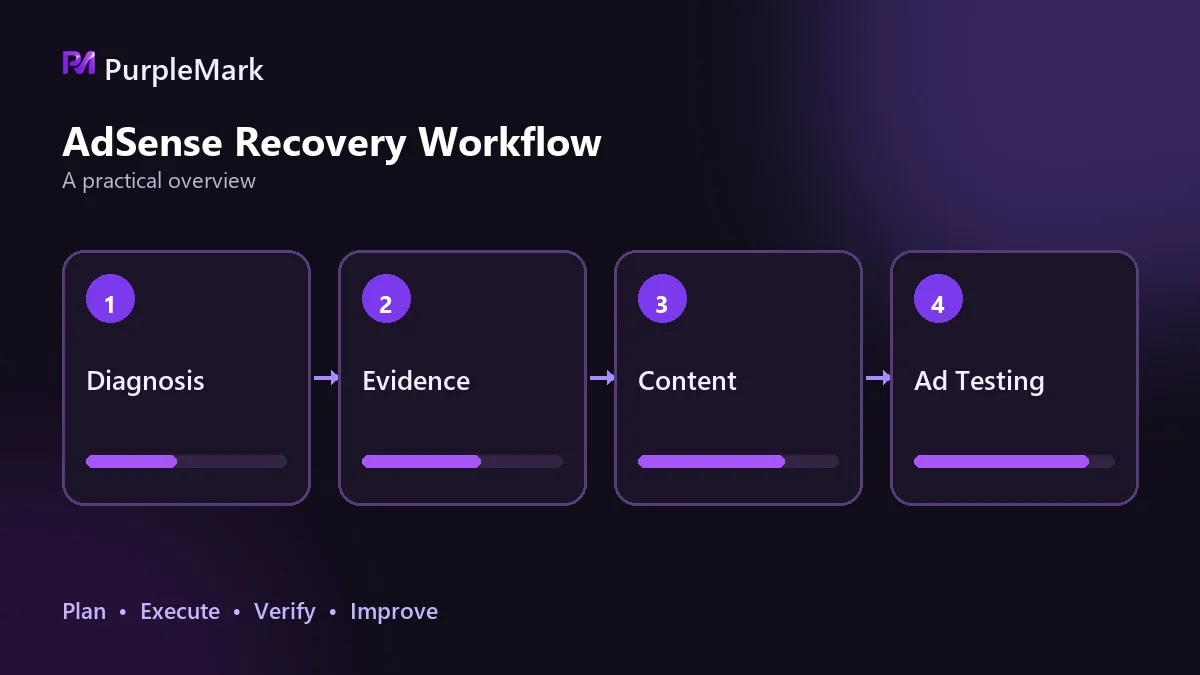
The notice is short, but the issue usually falls into a few categories
In practice, most restrictions fall into four areas: invalid traffic, content policies, copyright, and site experience or ad placement. The way to identify the problem is not to guess, but to use these four areas as a checklist and review the site item by item.
There is no room to experiment with invalid traffic
Invalid traffic is one of the most common issues. Clicking your own ads counts, and using another device or network to click them still counts because detection looks at data patterns rather than intent. Encouraging visitors to click through wording also counts, and impressions or clicks created by scripts or tools are even more clearly problematic.
One misconception is worth stating directly: some people treat a higher click-through rate as a metric they can optimize by testing copy that encourages clicks. That leads straight into invalid traffic. Revenue associated with invalid traffic is usually deducted, and the account may also be restricted. This is not a boundary to probe; it is a clear red line.
Hard limits on content and copyright
If site content falls into restricted categories, ads may stop showing on those pages. Because this area covers a wide range, the safer approach is to compare the site against the official policy guidance item by item instead of relying on assumptions.
Copyright risk is even easier to underestimate. Sites that aggregate other people's articles or repost film, video, or music without authorization remain risky even if their traffic is strong. A single infringement complaint can trigger action, and enforcement is often fast.
Another point is often overlooked: a site needs basic pages such as a privacy policy, an About page, and contact information. Missing these can make approval harder and may also count against the site's completeness in later reviews.
Page experience and ad placement
Problems often come from design choices: too many pop-ups covering the main content, pages made up almost entirely of ads, slow mobile loading, ads placed so close to buttons that they cause accidental clicks, or visual designs that make ads look like editorial content. These patterns all work against the user, and the platform tends to evaluate them on similar grounds.
After a restriction, the order of steps matters
Doing things in the wrong order can waste the effort. Start with a self-audit of the categories above, especially traffic sources and ad placements. Fix the specific issue first, then submit an appeal and explain what was changed and how.
Prepare supporting material for the appeal: site information, affected pages, and before-and-after comparisons. Screenshots and written explanations can be useful, so do not rush to delete pages or remove the site. If the evidence is deleted, there may be little left to support the appeal.
One more point can feel counterintuitive: repeatedly submitting appeals during a restriction does not speed up processing and may negatively affect later review.
After an appeal is rejected
A rejection is not necessarily the end. Continue correcting the site, finish anything that was only partly addressed, wait for a period, and submit again with a clear explanation of the additional changes.
Starting over with a new account is not recommended. Policy allows only one account per individual or business. If the original account truly cannot be restored, the proper path is to request closure of the original account before registering another one. If a new account is used to bypass enforcement and the accounts are linked, the new account may be actioned as well.
Multiple accounts using the same payment information or the same login environment are direct association signals. If multiple sites genuinely need to be operated, the account owner, payment information, and login environment should be kept separate. A structure in which Site A sends traffic to Site B can also be treated as traffic manipulation.
Keep an eye on these things every day
A simple routine is enough: check whether traffic sources look abnormal, whether content falls into restricted categories or infringes rights, and whether ad placements create accidental-click risks or excessive ad density.
Traffic sources deserve the most attention. They appear frequently in restriction notices and are easily affected by outside factors, such as purchased traffic or a sudden drop in the quality of a channel. The foundation of earnings is still the value of the page itself, and there is no shortcut around that.
For teams that need to manage login states across multiple sites at the same time, PurpleMark's multi-account environment capability can store each account environment separately and manage them centrally, reducing association risks caused by shared environments.


